
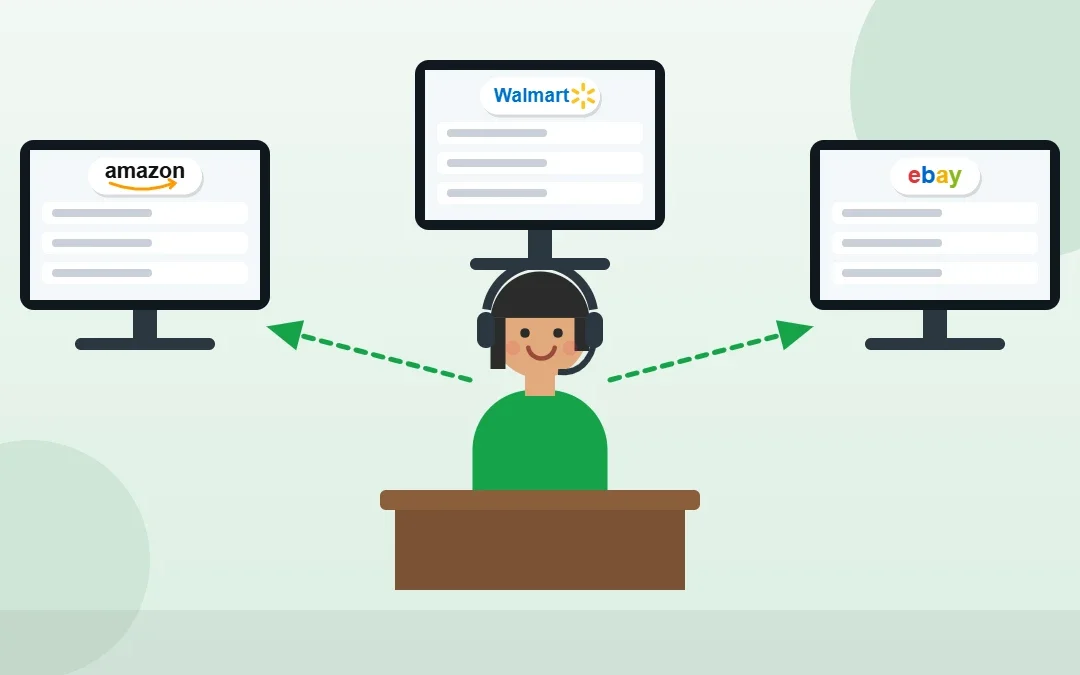
An ecommerce virtual assistant is one of the smartest hires a growing online seller can make. Selling on Amazon, Walmart and eBay at the same time is a fast way to grow, but it multiplies your workload: every marketplace has its own listing rules, inventory feed, order queue, buyer messages and performance dashboard.
In this guide you will see exactly what an ecommerce virtual assistant does on each marketplace, what a typical day looks like, how much an ecommerce virtual assistant costs, how to hire one and how to work together safely.
That is why more sellers now work with an ecommerce virtual assistant: a remote specialist who runs the day-to-day operations of your stores. In this guide you will see exactly what an ecommerce virtual assistant does on each marketplace, what a typical day looks like, how to work with one safely and how to tell if your business is ready.
Key Takeaways
Free presentation for students & teachers
14 slides · PowerPoint (.pptx), opens in Google Slides & Keynote · free to use with credit
- An ecommerce virtual assistant handles listings, inventory, orders, customer service, account health and reporting.
- Each marketplace has different rules, so experience with your specific channels matters.
- Always give your VA a separate user account with limited permissions, never your main password.
Table of Contents
- What Is an E-commerce Virtual Assistant?
- Core Tasks an E-commerce VA Handles
- Amazon vs Walmart vs eBay: What Changes
- A Typical Day for an E-commerce VA
- How to Work Safely With a Marketplace VA
- How Much Does an Ecommerce Virtual Assistant Cost?
- Skills to Look for in an Ecommerce Virtual Assistant
- How to Hire an Ecommerce Virtual Assistant in 5 Steps
- Meet Your Ecommerce Virtual Assistant
- Frequently Asked Questions
- Conclusion
What Is an E-commerce Virtual Assistant?
An ecommerce virtual assistant is a remote professional who specialises in online store operations. While a general VA might handle emails and scheduling, an ecommerce virtual assistant understands seller platforms such as Amazon Seller Central, Walmart Seller Center, eBay Seller Hub, Shopify and WooCommerce. They know how listings are structured, how orders flow and which metrics marketplaces use to judge sellers.
Most e-commerce VAs work part-time or on a monthly retainer, which makes them a cost-effective alternative to hiring a full-time operations employee.
Core Tasks an E-commerce VA Handles
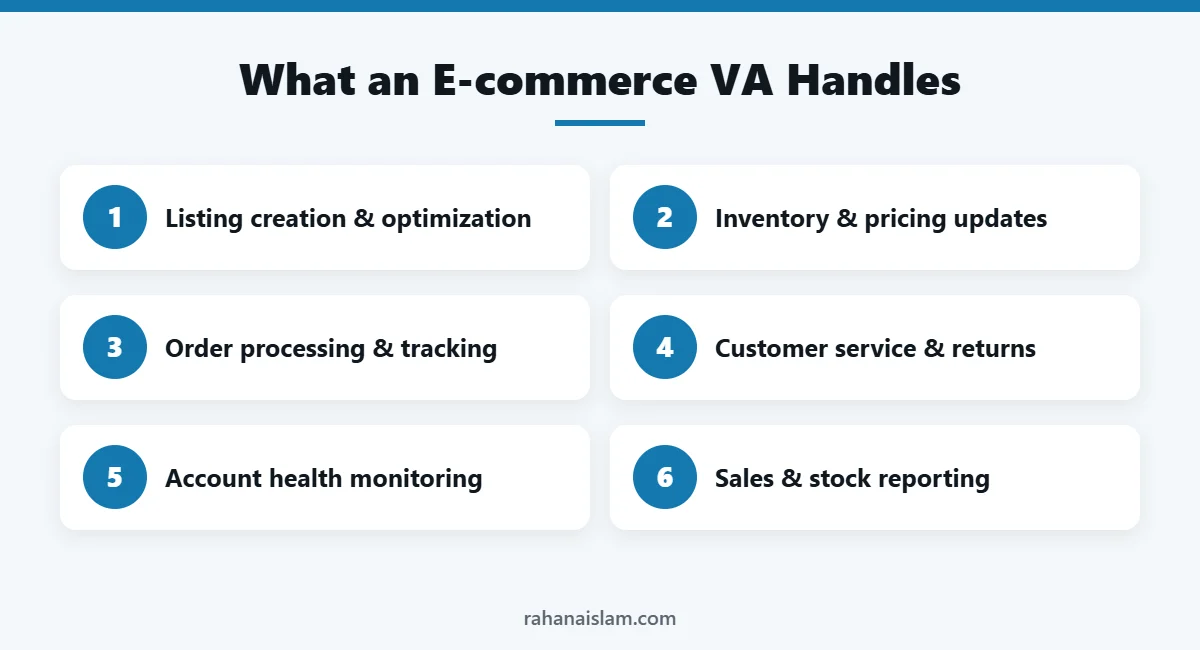
1. Product listing creation and optimisation
Your listing is your shop window. An ecommerce virtual assistant writes clear, keyword-rich titles, bullet points and descriptions within each marketplace’s rules, fills in item specifics so products appear in filtered searches, uploads images supplied by your brand and sets up variations such as size and colour correctly. They also fix suppressed or inactive listings, which is one of the most common hidden causes of lost sales.
2. Inventory and pricing management
Overselling an out-of-stock product leads to cancellations, and cancellations hurt your account health. A VA keeps stock levels synchronised across channels, applies price changes based on your rules, flags low-stock items for reordering and coordinates with suppliers or your warehouse when needed.
3. Order processing and fulfilment
Every order needs to be confirmed, fulfilled and tracked on time. Depending on your setup, your VA can process orders, send them to a supplier or fulfilment partner, upload tracking numbers, monitor late shipments and handle cancellations according to marketplace policy.
4. Customer service and buyer messages
Marketplaces expect fast, professional replies. A VA answers pre-sale questions, provides order updates, handles returns and refunds, resolves delivery problems and follows up on negative feedback politely. Using saved replies and clear guidelines keeps every answer consistent with your brand voice.
5. Account health monitoring
Amazon, Walmart and eBay all track seller performance using metrics such as late shipment rate, cancellation rate, valid tracking rate, response time and policy compliance. A VA checks these dashboards regularly and alerts you to warning signs before they turn into restrictions.
6. Reporting and insights
Data from three marketplaces is hard to read at a glance. A VA can compile a weekly or monthly report covering sales by channel, best and worst sellers, stock levels, returns and customer issues, so you can make decisions quickly.
Amazon vs Walmart vs eBay: What Changes
The core work is similar on every platform, but the details differ. An experienced VA adapts to each marketplace’s rules and priorities.
| Area | Amazon | Walmart | eBay |
|---|---|---|---|
| Seller dashboard | Seller Central | Seller Center | Seller Hub |
| Listing focus | Strict style guides, A+ Content for brands | Strong focus on content quality and attributes | Item specifics and clear photos matter most |
| Key performance metrics | Order defect rate, late shipment, cancellations | On-time delivery, valid tracking, cancellations | Transaction defects, late shipments, cases closed |
| Customer messages | Reply expected within 24 hours | Reply expected within 48 hours | Fast replies improve seller standards |
| Typical VA tasks | Listings, FBA shipments, case logs, reports | Item setup, inventory feeds, order updates | Listings, offers, returns, feedback follow-up |
Marketplace policies change regularly. Always check the latest requirements in each seller help centre.
A Typical Day for an E-commerce VA
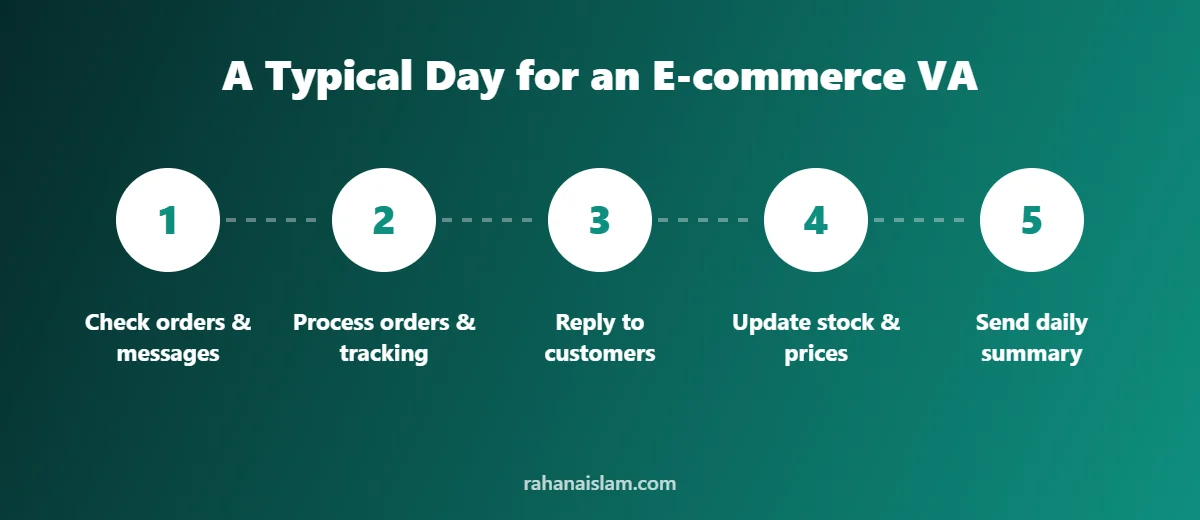
Every business is different, but a well-run day usually follows a predictable rhythm:
- Morning check: review new orders, buyer messages and any account notifications on every channel.
- Orders and tracking: process orders and upload tracking numbers before carrier cut-off times.
- Customer service: answer questions, approve returns and resolve delivery issues.
- Inventory and prices: update stock levels and apply any planned price changes.
- Project work: improve listings, upload new products or work on SEO.
- End-of-day update: send a short summary of completed work and anything that needs your decision.
How to Work Safely With a Marketplace VA
- Use user permissions, not your password. Amazon, Walmart, eBay, Shopify and WooCommerce all let you add users with limited access. This protects your account and lets you remove access instantly if needed.
- Turn on two-factor authentication for every seller account.
- Document your rules. Pricing rules, return policy, refund limits and message templates make decisions faster and more consistent.
- Agree on a reporting rhythm. A short daily or weekly update keeps you informed without micromanaging.
- Start with a trial. A two to four week trial with clear tasks shows you quality and communication before you commit.
New to working with a VA? Read 7 Signs You Need a Virtual Assistant and How to Onboard a Virtual Assistant for a step-by-step plan.
How Much Does an Ecommerce Virtual Assistant Cost?
The cost of an ecommerce virtual assistant depends on experience, the platforms you sell on and how many hours you need. As a general guide:
- Entry-level ecommerce virtual assistant: around $5 to $8 per hour for data entry, simple listings and order updates.
- Experienced ecommerce virtual assistant: around $7 to $15 per hour for multi-channel operations, listing optimisation and account health monitoring.
- Specialist or agency: $20 per hour and above for advanced advertising, brand management or full account management.
Many sellers start with a fixed package or 10 to 20 hours per week, then move to a monthly retainer once the ecommerce virtual assistant knows their products and processes.
Skills to Look for in an Ecommerce Virtual Assistant
- Platform experience: hands-on work in Amazon Seller Central, Walmart Seller Center, eBay Seller Hub, Shopify or WooCommerce.
- Attention to detail: a single wrong price or SKU can cause losses or cancellations.
- Clear written English: essential for buyer messages, listings and case logs with seller support.
- Spreadsheet skills: inventory files, bulk uploads and reports usually live in Excel or Google Sheets.
- Policy awareness: a good ecommerce virtual assistant knows marketplace rules and keeps your account compliant.
Always check reviews and ask for examples of similar stores the ecommerce virtual assistant has supported.
How to Hire an Ecommerce Virtual Assistant in 5 Steps
- List your tasks by marketplace and estimate weekly hours.
- Write a short job description naming your platforms and tools.
- Shortlist candidates with proven marketplace experience and strong reviews.
- Run a paid test task, such as updating 10 listings or answering sample buyer messages.
- Start with a trial period, then scale hours as quality is proven.
Marketplace rules change often, so keep official resources handy: Amazon seller policies, the Walmart Marketplace Learn centre and the eBay seller help pages.
Meet Your Ecommerce Virtual Assistant
Prefer to see who you would be working with? Here is a quick one-minute introduction to how I support online businesses as a remote virtual assistant.
Official sources: Amazon: Sell on Amazon · Walmart Marketplace Learn · eBay: Seller help
Frequently Asked Questions
What does an Amazon virtual assistant do?
An Amazon VA manages listings, inventory, orders, FBA shipments, buyer messages, case logs with Seller Support and performance monitoring in Seller Central. Many also help with keyword research and listing optimisation.
Can one VA manage Amazon, Walmart and eBay together?
Yes. Many experienced e-commerce VAs manage several marketplaces at once, which keeps inventory, pricing and customer service consistent across all your channels.
How many hours does an ecommerce virtual assistant need per week?
Small stores often start with 10 to 20 hours per week. Busy multi-channel sellers may need a full-time VA or several part-time specialists.
Will a VA have access to my money or payouts?
It should not need to. Set up user permissions so your VA can manage listings, orders and messages but cannot change bank details, payment settings or payouts.
Is an ecommerce virtual assistant worth it for a small store?
Yes, if orders, messages and listing updates take more than a few hours a week. An ecommerce virtual assistant frees you to focus on sourcing, marketing and growth.
Can an ecommerce virtual assistant run Amazon ads?
Some can. Basic campaign monitoring and reporting are common VA tasks, while full PPC strategy is usually handled by an advertising specialist.
Budgeting for help? See how much a virtual assistant costs in 2026, with rates by country and a free calculator.
Conclusion
An ecommerce virtual assistant keeps your stores accurate, your customers happy and your account health strong, while you focus on sourcing, marketing and growth. Start with the daily essentials, document your processes and expand the role as trust builds.
Ecommerce Management Services
Want an experienced hand running your Amazon, Walmart, eBay or Shopify store? See my ecommerce management services and the real Amazon case study.
📌 Save this guide for later
Pin it to your Pinterest board so you can find it again when you need it.

About the Author
Rahana Islam
Virtual Assistant & E-commerce Specialist with 7+ years of remote experience supporting businesses in the United States, Denmark and worldwide with WordPress, Shopify, Amazon, Walmart and eBay operations. Level 2 Fiverr seller with a 5.0★ rating from 167 reviews, an NSDA-certified trainer & assessor and the #1 LEDP earner of Dhaka district.
Need Help Running Your Marketplaces?
I manage listings, inventory, orders, customer service and reporting across Amazon, Walmart, eBay, Shopify and WooCommerce.